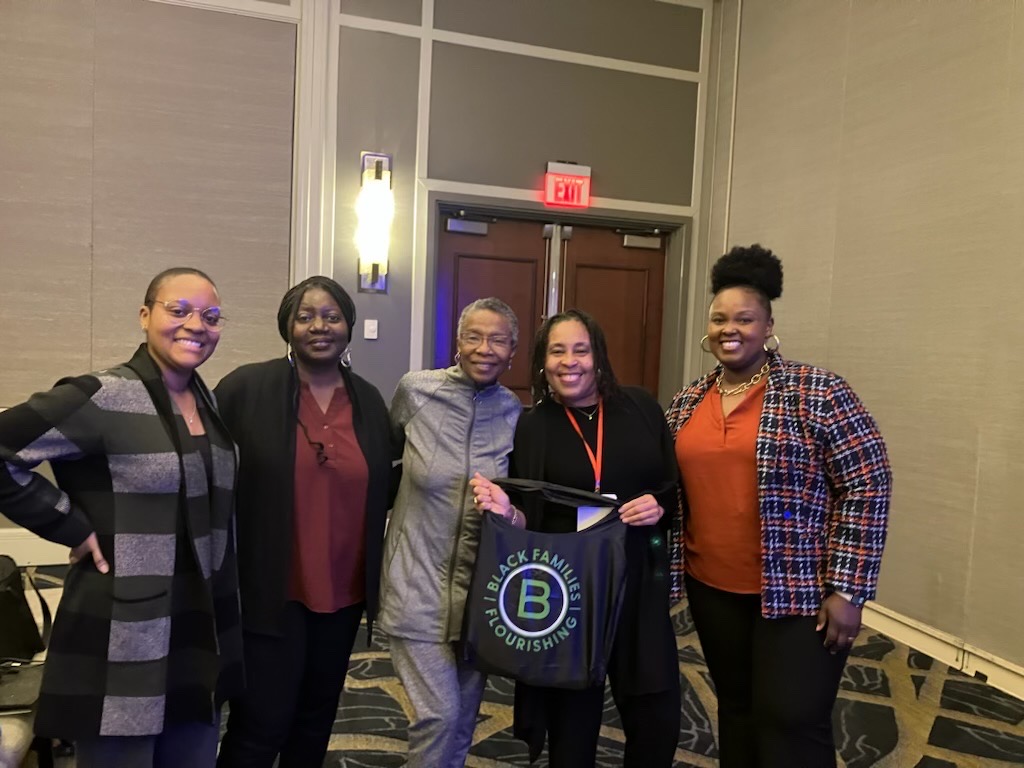
Last month, members of the Black Families Flourishing (BFF) team attended the National Council for Black Studies (NCBS) Conference in Baltimore, MD. This year’s 50th annual conference brought together scholars, researchers, students, and community members across four days with a theme of “uMkhonto weSizwe (Spear of the Nation): Black Studies as Uncompromising Liberation.”
BFF hosted our own session at the conference entitled “Examining 100 Years of Research Focused on Black Families to Inform the Future,” which included methodological and theoretical findings from a 100-Year Review of Research on Black Families to set the stage for updates on current BFF research. Chrishana M. Lloyd, BFF’s principal investigator and project lead, provided an overview of research on Black families and contextualized how the collaborative BFF project extends this work. Quiana Lewis Wallace, BFF’s co-deputy research lead, shared how Black families are defined in the BFF project and noted the implications of this definition for how we study the concept of flourishing. Shana E. Rochester, BFF’s co-deputy research lead, presented preliminary findings from a study on how local policies that govern the systems with which Black families and children interact may identify conditions for flourishing. Zakia Redd, BFF’s senior advisor, closed out the session by providing a high-level synthesis of the presentations to stimulate audience questions.
We also had the pleasure of attending other insightful sessions at the conference, including the local host plenary, “From Uprisings to Liberation: The Struggle for Black Lives and Communities in Baltimore in the Aftermath of Freddie Gray.” The speakers highlighted grassroots initiatives that are strengthening policies in and promoting accurate media representation of the city. Dayvon Love, director of public policy for Leaders of a Beautiful Struggle, discussed the importance of Black political organizing in contributing to the recent drop in Baltimore’s crime rate. Karsonya “Kaye” Wise Whitehead, president of The Association for the Study of African American Life and History and the founding executive director of The Karson Institute for Race, Peace & Social Justice at Loyola University Maryland, emphasized the role of local media as an organizing tool for daily acts of resistance against misinformation. Her daily radio show Today with Dr. Kaye on WEAA (We Educate African Americans) 88.9FM connects national topics to local issues in Baltimore City and offers informed opinions to inspire listeners to take action. Shvilla Rasheem, the executive director and producer of the Baltimore Legacy Project, spoke about how she uses her expertise as an independent scholar and social scientist to make documentaries that tell Baltimore’s story from the experience of its elder Black residents.
The conference and many of the sessions were aligned with BFF’s focus on strengths-based research that contributes to the well-being of Black people, including Black families. The BFF team looks forward to continuing to engage with scholars, practitioners, and communities in support of advancing research and policies that promote flourishing in Black families.